
Digitalisation
Information
Technology
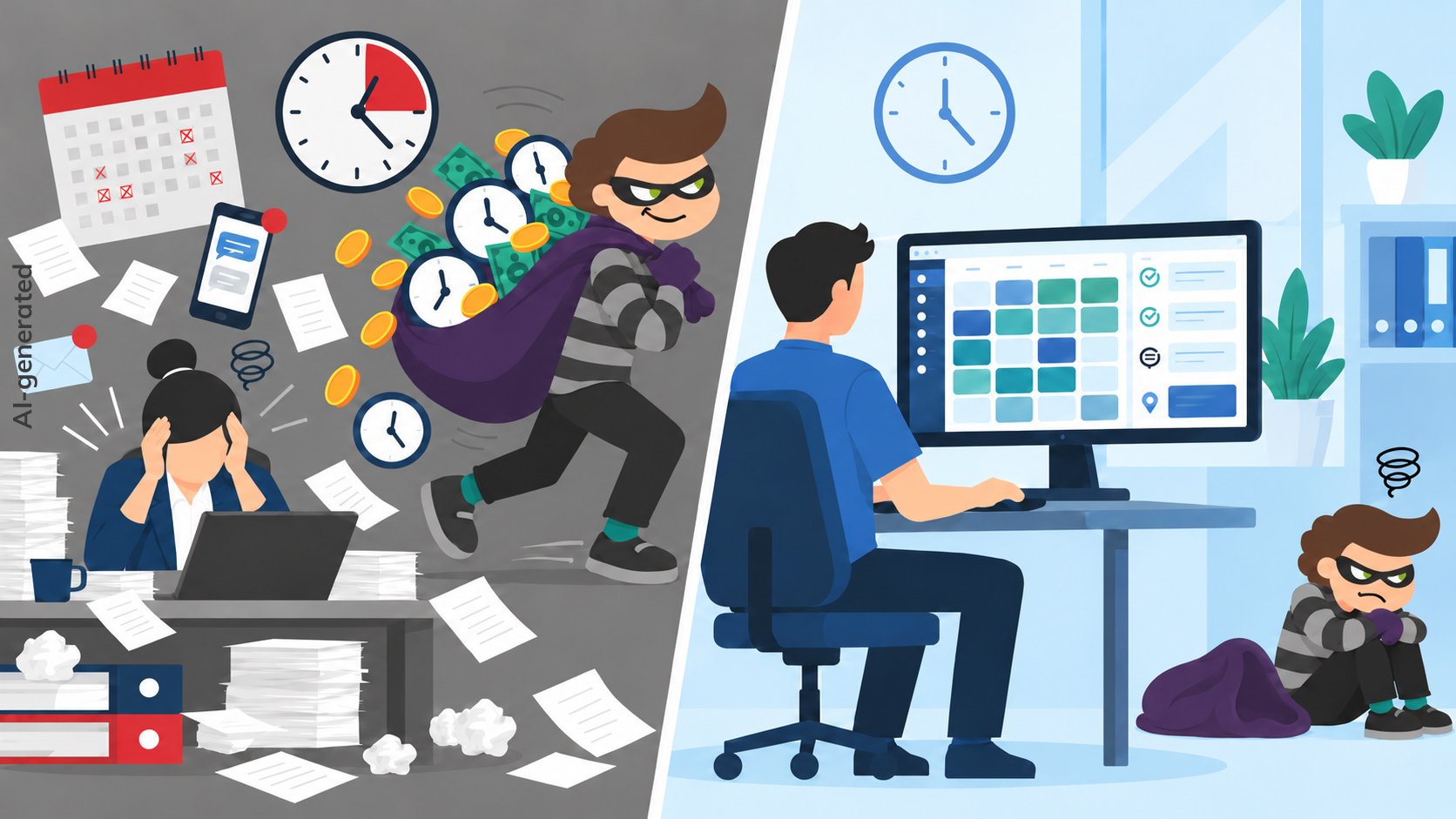

The cover image for this article was generated using the AI tool ChatGPT.
You’re busy, and the business is in full swing. Yet hours disappear, and you can’t see where.
The thief has several hiding places. One of them is the small jobs nobody keeps an eye on. Your employee empties the dishwasher at the client’s. Again. It isn’t part of the agreement, and nobody has said it should be registered. After a month, it has added up to a couple of hours the client should have paid for, but which you’ve never invoiced. Nobody has done anything wrong. The hours just never became visible, so a bill was never sent.
But the biggest hiding place isn’t out on the cleaning job at all. Did you know the biggest time thief hides in admin?
The thief doesn’t take a whole day at a time. It takes five minutes here and ten minutes there. A sick day that needs covering. A missing time registration. An invoice that needs correcting. Each thing seems small. But they add up, and because it happens in pieces, you never see the loss as a whole. And the more clients you win, the more the thief can take. More work schedules, more hours to register, more invoices and more coordination.
So if you’re wondering where the hours go, start by looking at your admin.
Imagine an ordinary working week. Your employees have been given their jobs and the time set aside for them. But what happens when a job takes less time than planned? Perhaps some of that time goes on waiting, even though your employees could have moved on to the next job.
At the same time, clients come with small extra jobs along the way. “Can’t you just do this as well?” It may seem like a small thing, but when the extra jobs add up over a week, they can suddenly become many hours of work that never get invoiced.
The result? You lose both valuable working time and money, without necessarily noticing.
An employee calls in sick, and the schedule has to be adjusted. Another has forgotten to register their hours. A client has ordered an extra job that needs invoicing. An employee phones to get details of today’s job. Later, a client asks for documentation of the work carried out.
None of these tasks necessarily seems particularly time-consuming.
The problem is that they all land on top of each other.
Scheduling, reshuffling, time and attendance, payroll corrections, invoicing, documentation, emails and coordination are all necessary parts of running the business. But if the processes require a lot of manual steps, they can quickly take up more time than you realise.
Some of that time probably also goes on what’s best described as firefighting. You react to the next problem that crops up, instead of spending your time on the tasks you’d actually planned.
Because it’s rarely one big task that steals your time. It’s the many small ones.
Admin is necessary for running a cleaning business.
The problem isn’t the employee, the operations manager or the person who handles payroll and invoicing.
The problem arises in the friction between the many small processes.
Imagine an employee calls in sick.
First, you need to find a replacement. Then the schedule has to be changed. The replacement needs to be told the time, place and task. The client may need to be informed. Afterwards, you need to make sure the hours are registered correctly and that the right information’s passed on to payroll and invoicing.
One sick day isn’t likely to bring any major disasters, but the many steps needed to sort it out might.
The same happens when a timesheet’s missing, an extra job needs tracking down, an invoice needs correcting, a client asks for documentation, or an employee lacks information.
Admin rarely steals many hours at once.
It steals your time bit by bit.

It can be hard to relate to five minutes here and ten minutes there. That’s why it becomes interesting when you add the time together.
Imagine, for example, that you can free up 8.5 hours of admin a month.
Over a year, that adds up to:
102 hours.
The question isn’t just that you’ve saved 102 hours.
The question is:
What could your business do with 102 extra hours?
Could you:
Saved hours aren’t the end result. They’re the capacity you get back.
It can be hard to know how much time admin actually takes until you put a number on it. With CleanManager’s business case calculator, you can find out where time disappears in your own business.
If you want to find out where admin takes up the most time, you can start by looking at some of the processes that repeat in your day-to-day work.
How much time goes into planning and changing work schedules? And what happens when things don't go to plan?
A single sick day can set off a whole chain of tasks. A replacement has to be found, employees and perhaps clients have to be informed, and the schedule has to be updated.
It's worth asking:
How much admin does a single sick day create?
How much of the working day goes on firefighting and changes?
And does the operations manager know whether the employee's actually turned up at the client's site?
If the answer requires yet another call or message, that's another small admin task in the process.
How much time does the business spend collecting, checking and correcting employees' hours?
And how much manual work does employee administration require in general?
It could be registering hours, changes to work schedules, absence, information about jobs or checking that the registered information's correct.
Time registration is also important for another reason. It can tell you something about the profitability of your client jobs.
If the registered hours deviate from the quoted time, that's not necessarily a problem. Some jobs take a little longer, others a little less. But if the deviation repeats week after week and across several clients, it can affect your earnings.
Conversely, consistently fewer hours spent than expected may be worth investigating. Perhaps the job's being done more efficiently than expected.
So the question isn't just:
Are the hours registered correctly?
It's also:
Do the registered hours match the time you quoted for the job?
When you can compare expected and actual time spent, it's easier to spot deviations and investigate why they occur.
Once the hours are registered, what happens to the information?
Does it need to be checked manually?
Does anything need correcting before payroll can run?
Does data need to be moved or keyed in again in another system.
The more times the same information has to be handled, the more time the business spends on admin, and the more places errors can potentially creep in.
The same applies to invoicing.
Does all the work the business carries out actually get invoiced?
If a client orders an extra job, it doesn't just need to be carried out. It also needs to be registered and end up on the right invoice. Otherwise, the business risks delivering work without being paid for it.
Where's the information about each client and job stored?
If an employee lacks information, can they find it themselves? Or do they have to contact the office?
If a client asks for documentation, can you find it quickly? And what happens if the client complains about a job?
How much time goes on finding out who carried out the work, when it was done, which hours were registered and what was actually agreed?
The better your documentation and information flow, the easier it is to respond to questions and complaints without first having to gather information from several places.
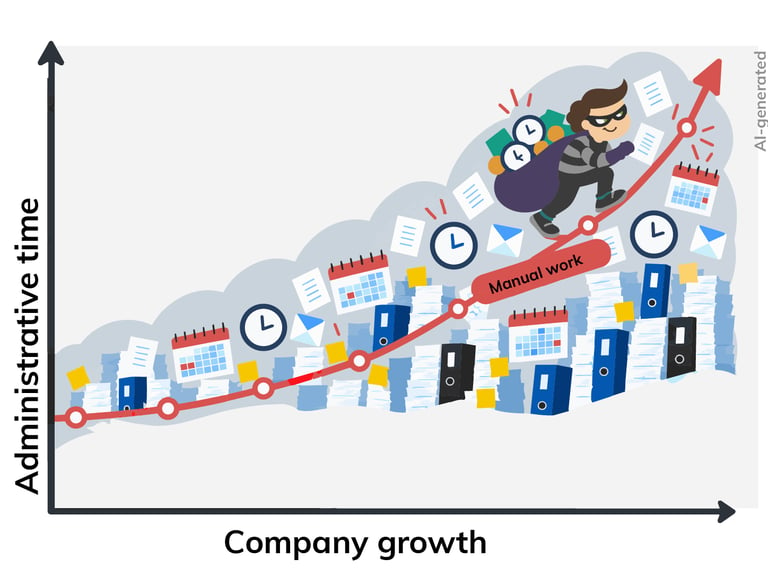
IIt’s a bit like family life.
Having one child with school, after-school activities and appointments can be fairly simple to coordinate. But if you suddenly have three children who need to get to football, swimming and scouts at different times, or perhaps even at the same time, the need for planning and coordination quickly grows.
The same happens in your business.
More clients mean more jobs.
More jobs require more employees.
More employees mean more work schedules, more changes and more registered hours.
And that in turn leads to more payroll information, more invoices and more communication.
More clients → more employees → more schedules → more hours → more payroll and invoicing → more coordination
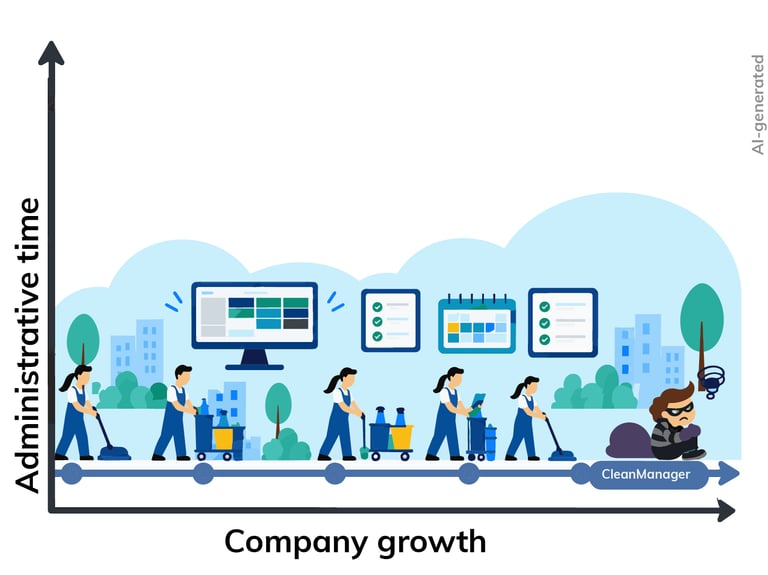
Growth naturally brings more admin. It just doesn’t have to grow as fast as the business.
If every new client requires a corresponding amount of extra manual work in the office, admin can eventually become a bottleneck.
You may have the opportunity to win more clients, but lack the time to handle the admin that comes with them.
Imagine instead that more of the information you already have can be used throughout the business's workflows.
That information about scheduling, employees and hours doesn't constantly have to be tracked down or typed in again.
That you can get an overview of registered hours more quickly.
That information for payroll and invoicing doesn't require the same amount of manual work. And that employees can more easily find the information they need.
Becoming more efficient isn't just about saving a few minutes here and there. It's about building a business that can handle more without admin growing at the same rate.
It's about being able to handle more activity without admin keeping pace.
Admin time saved isn't just pounds and pence.
It can also be the foundation for new capacity.
If the business frees up a few hours each month, they can be used, for example, to:
So what matters isn't just how many hours you can save. What's interesting is what you and your business can do with them. Because your admin shouldn't stand in the way of your next client.
It can be hard to know how much time admin actually takes until you put a number on it.
How much time do you spend on scheduling?
How much goes on checking hours?
How much time do you spend on payroll, invoicing and documentation?
And how many minutes disappear each week on finding information or correcting small errors?
CleanManager is built for the cleaning industry and helps create connections between the key parts of day-to-day operations:
Scheduling → employees → hours → payroll → invoicing → documentation
The idea’s simple.
When information already exists in one place in the business, it shouldn’t constantly have to be:
When workflows fit together better, you can reduce some of the manual work and get a better overview of operations at the same time.
In that way, a digital system isn’t just about moving admin from paper to a screen.
It’s about optimising the workflows behind the admin.
Read our article, Spot These 5 Hidden Patterns Before They Cost You, to see which patterns can cost you money and which ones you should keep a close eye on.
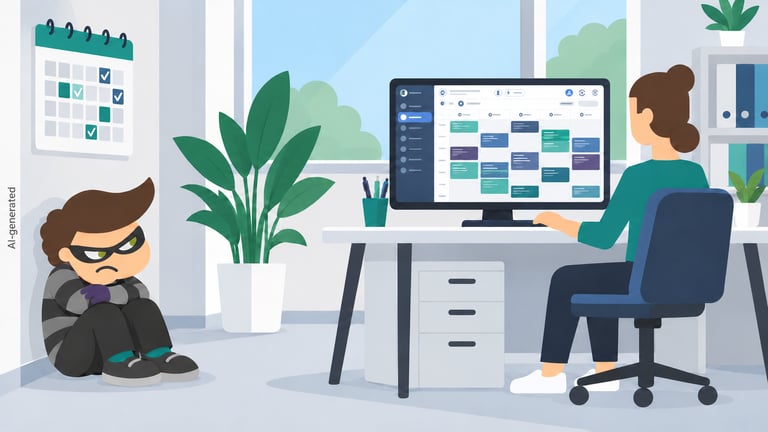
The images in this article were generated using the AI tool ChatGPT.